
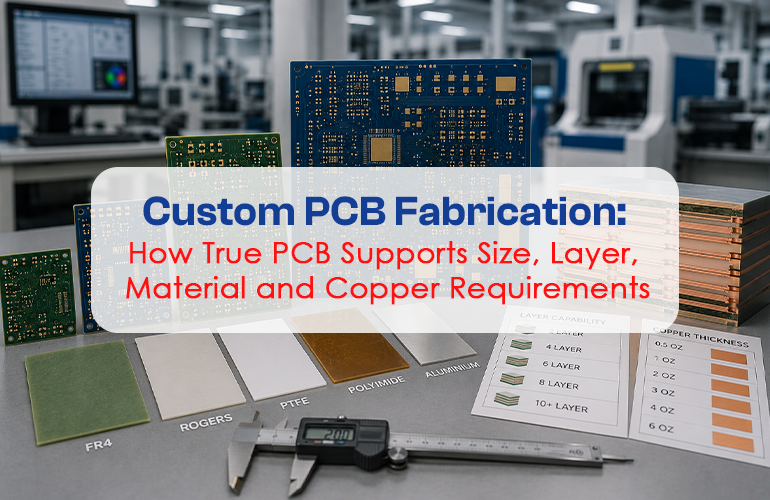
Custom PCB fabrication is important when a standard PCB solution cannot meet the needs of a specific project. Every electronic product has different requirements based on size, layer count, material, copper thickness, surface finish, and performance.
Custom PCB fabrication allows engineers to build boards according to the exact needs of the application. This is useful for prototypes, small batch orders, industrial electronics, R&D projects, and technically demanding products.
What Is Custom PCB Fabrication?
Custom PCB fabrication means manufacturing printed circuit boards based on specific design and performance requirements. Instead of following one common format, the board is created according to the customer’s technical needs.
This may include custom dimensions, special materials, multilayer construction, controlled impedance, high copper thickness, fine tracks, blind vias, buried vias, or unique surface finish requirements.
Custom Size Requirements
Many products require PCBs that fit within specific enclosures or mechanical spaces. A custom PCB size helps the board match the final product design.
This is important for compact electronics, industrial devices, automotive modules, control panels, and communication systems.
Layer Count Requirements
Some products need simple single-sided or double-sided PCBs. Others require multilayer boards for complex routing and higher circuit density.
Custom PCB fabrication allows engineers to select the right layer count based on functionality, signal requirements, and available space.
Material Requirements
Different applications need different materials. FR4 may work for standard electronics, while Rogers, PTFE, Polyimide, Aluminium, or other special materials may be required for high-frequency, thermal, flexible, or performance-sensitive applications.
Choosing the right material helps improve long-term reliability.
Copper Thickness Requirements
Copper thickness affects current carrying capacity and heat behavior. High-current applications may require thicker copper, while fine circuit designs may need controlled copper thickness for accurate tracks.
Custom copper requirements help the PCB match its electrical load and performance needs.
Surface Finish and Testing
Surface finish protects exposed copper and supports solderability. Testing helps verify that the PCB meets quality and reliability requirements.
Custom PCB fabrication should include proper planning for both finish selection and inspection.
How True PCB Supports Custom PCB Fabrication
True PCB offers custom PCB fabrication solutions for size, layer count, material type, copper thickness, and performance needs. Its fabrication services support prototype PCB builds, small batch orders, industrial PCB projects, custom dimensions, special material requirements, and fast development runs.
True PCB also supports single side, double side, and multilayer PCB fabrication, along with controlled impedance boards, blind and buried vias, fine track designs, precision drilling, and surface finish options. This makes True PCB a practical manufacturing partner for application-specific PCB requirements.
Conclusion
Custom PCB fabrication helps engineers create boards that match exact product needs. Size, layer count, material, copper thickness, surface finish, and testing all play an important role in final performance.
By choosing a PCB manufacturer with custom fabrication capability, businesses can build boards that are better suited for real-world applications and production requirements.