
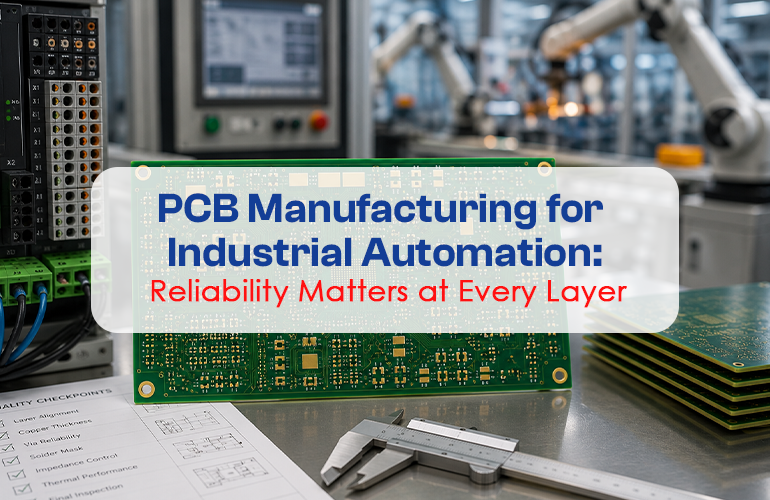
PCB manufacturing for industrial automation requires strong reliability, accuracy, and long-term performance. Industrial automation systems often work continuously in demanding environments. These systems depend on control boards, sensor boards, power circuits, communication modules, and monitoring electronics.
If the PCB fails, the entire automation process can stop. This can lead to downtime, maintenance costs, and production delays. Therefore, reliable PCB manufacturing is extremely important for industrial automation applications.
Why Industrial Automation Needs Reliable PCBs
Industrial automation systems are used in factories, machines, process control equipment, robotics, and monitoring systems. These applications often involve continuous operation, electrical loads, heat, vibration, and environmental exposure.
A PCB used in such systems must be manufactured with controlled processes, proper material selection, and strong inspection support.
Importance of Multilayer PCB Design
Many industrial automation boards need compact layouts with multiple functions. Multilayer PCBs help engineers manage signal routing, power distribution, and control circuits in a smaller space.
A proper multilayer PCB structure improves performance and supports complex automation requirements.
Heat and Current Handling
Industrial systems may include power control, motor drives, relays, and high-load circuits. These applications require proper copper thickness, trace width, and heat management.
If current and heat are not planned correctly, the PCB may face overheating, voltage drop, or early failure.
Signal Stability
Automation systems often use sensors, controllers, and communication interfaces. Signal stability is important because inaccurate signals can affect machine performance.
Controlled layout, proper spacing, material selection, and testing help improve signal reliability.
Testing and Inspection
PCB testing is important before the board is used in industrial equipment. Electrical testing, AOI inspection, impedance testing, contamination testing, and other inspection processes help identify issues early.
Testing helps ensure that the board is not only manufactured but also ready for industrial use.
How True PCB Supports Industrial Automation PCBs
True PCB supports industrial PCB projects through prototype PCB manufacturing, small batch orders, multilayer PCB fabrication, controlled impedance boards, fine track designs, precision drilling, and surface finish options. These capabilities are useful for industrial automation boards that need accuracy, consistency, and application-specific performance.
True PCB also supports PCB testing services such as flying probe, AOI, contamination, impedance, and other inspection tests. This helps industrial customers verify board quality before assembly or use.
Conclusion
PCB manufacturing for industrial automation must focus on reliability at every layer. From material selection and copper thickness to multilayer design and testing, every detail affects performance.
A reliable PCB manufacturer helps industrial businesses reduce downtime, improve product confidence, and build automation systems that can perform consistently in demanding conditions.