
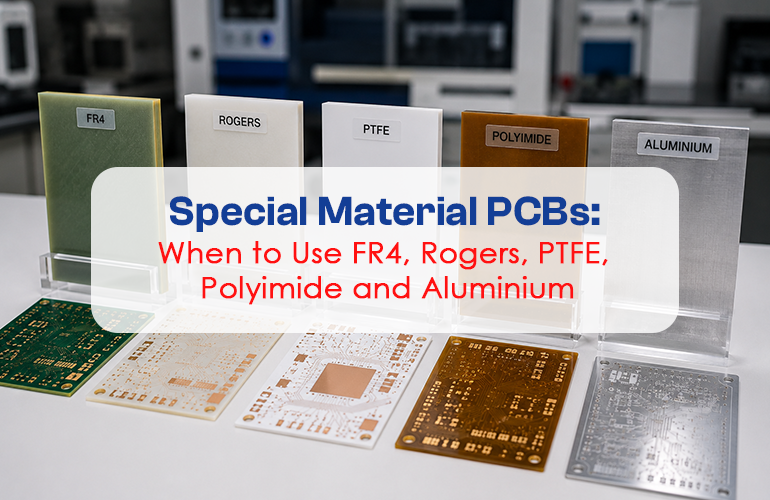
Special material PCBs are used when standard board materials are not sufficient for the application. Different electronic products operate in different environments. Some boards require better heat management, others need high-frequency stability, flexibility, or higher reliability.
Choosing the right PCB material improves performance, reduces failure risk, and ensures the board meets application demands. Common materials include FR4, Rogers, PTFE, Polyimide, and Aluminium, each selected based on electrical, thermal, and mechanical requirements.
Why Special Material PCBs Matter
The PCB material affects signal quality, heat resistance, insulation, strength, flexibility, and durability. Selecting the wrong material may result in poor performance or failure under real-world conditions.
Special material PCBs are essential for applications where stability and reliability are critical. This includes RF systems, telecom equipment, LED lighting, power electronics, medical devices, industrial equipment, and automotive electronics.
FR4 for Standard Applications
FR4 is widely used due to its good electrical insulation, mechanical strength, and overall practical performance.
- Applications: Control boards, consumer electronics, industrial devices, prototypes, standard multilayer PCBs
- Advantages: Cost-effective, versatile, and ideal for most standard electronic designs
Rogers for High-Frequency Applications
Rogers material provides stable high-frequency performance, reduces signal loss, and improves electrical consistency.
- Applications: Telecom, antennas, RF control boards, high-speed electronics
- Advantages: Excellent for designs where signal integrity is critical
PTFE for RF and Microwave Designs
PTFE offers strong high-frequency stability and is ideal for RF, microwave, and communication applications.
- Applications: RF circuits, antennas, high-frequency communication boards
- Advantages: Maintains signal quality but requires careful manufacturing handling
Polyimide for Flexibility and Heat Resistance
Polyimide is chosen when flexibility, heat resistance, or compact movement is required.
- Applications: Flexible PCBs, wearable electronics, aerospace, space-constrained designs
- Advantages: Handles demanding conditions while maintaining performance
Aluminium for Thermal Management
Aluminium PCBs are used where heat dissipation is critical. The metal base transfers heat away from components, improving performance and product longevity.
- Applications: LED lighting, power electronics, heat-sensitive circuits
- Advantages: Effective thermal management for high-power applications
How TruePCB Supports Special Material PCBs
TruePCB works with engineers, startups, and companies to select the right PCB material for each application. They provide support for:
- FR4, Rogers, PTFE, Polyimide, Aluminium, and other specialized materials
- Aligning material choice with PCB type, assembly process, and performance needs
- Prototype and small batch PCB manufacturing for testing, validation, and pilot runs
This guidance ensures that the PCB base material matches the product requirements, whether for high-frequency stability, thermal support, flexibility, or general performance.
Conclusion
Special material PCBs improve performance in specific applications. FR4, Rogers, PTFE, Polyimide, and Aluminium each serve unique purposes.
Discussing material selection with your PCB manufacturer early ensures reliability, better performance, and longer product life. TruePCB helps engineers select the right material and manufacturing process to create high-quality boards tailored to application needs.