
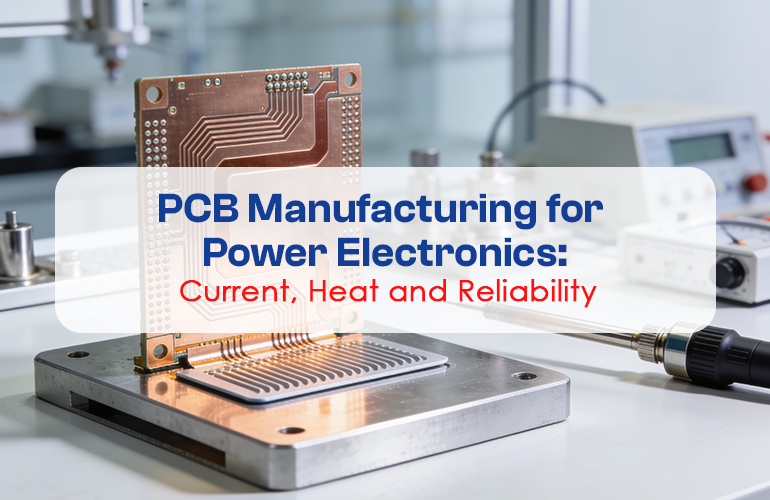
PCB manufacturing for power electronics requires more attention than standard circuit board production. Power electronic systems handle higher current, heat, and electrical stress. Because of this, the PCB must be designed and manufactured for strong current carrying capacity and thermal reliability.
Power electronics are used in industrial systems, power supplies, battery systems, motor controllers, renewable energy equipment, and automotive electronics. In these applications, PCB failure can affect the entire product or system.
Why Power Electronics Need Special PCB Planning
Power electronics do not only transfer signals. They also carry significant electrical load. This means the PCB must handle current without overheating or losing performance.
For this reason, engineers must consider copper thickness, trace width, board material, thermal design, spacing, and testing before production.
Current Carrying Capacity
The current carrying capacity of a PCB depends on copper thickness, trace width, temperature rise, and layout design. If these factors are not planned correctly, the board may heat up or fail during operation.
Power electronics PCBs often need wider traces or higher copper thickness to support heavy current flow.
Heat Management
Heat is one of the biggest challenges in power electronics. Components such as power MOSFETs, regulators, drivers, and converters can generate heat during operation.
The PCB must support heat transfer through copper areas, material choice, thermal design, and sometimes metal core structures. Better heat management improves product life and reliability.
Material Selection
Material choice affects how the PCB handles heat and electrical stress. Standard materials may work for moderate applications, while special materials may be required for higher thermal or electrical demands.
Choosing the right material helps improve performance under real operating conditions.
Spacing and Safety
Power electronics may involve higher voltages. Proper spacing between conductive areas is important to reduce the risk of electrical failure.
Designers should carefully plan creepage, clearance, isolation areas, and copper spacing according to the application requirement.
Testing and Inspection
Power electronics PCBs must be tested carefully before use. Electrical testing, visual inspection, copper verification, and reliability checks help ensure that the board can perform under load.
Testing helps identify faults before the board reaches the final product.
How True PCB Supports PCB Manufacturing for Power Electronics
True PCB supports PCB manufacturing requirements for power electronics through high copper build PCB capability, material selection, surface finish options, and inspection support. These capabilities help customers develop boards that need better current handling and thermal reliability.
For power-focused applications, True PCB helps manufacture boards with attention to copper requirements, hole quality, layer structure, and testing. This makes it suitable for customers working on industrial systems, high-load circuits, energy equipment, and performance-driven electronic products.
Conclusion
PCB manufacturing for power electronics requires careful planning of current, heat, copper thickness, spacing, and reliability. A standard approach may not be enough for high-load applications.
With the right PCB design and manufacturing support, power electronics boards can perform more safely, reliably, and consistently in demanding environments.