
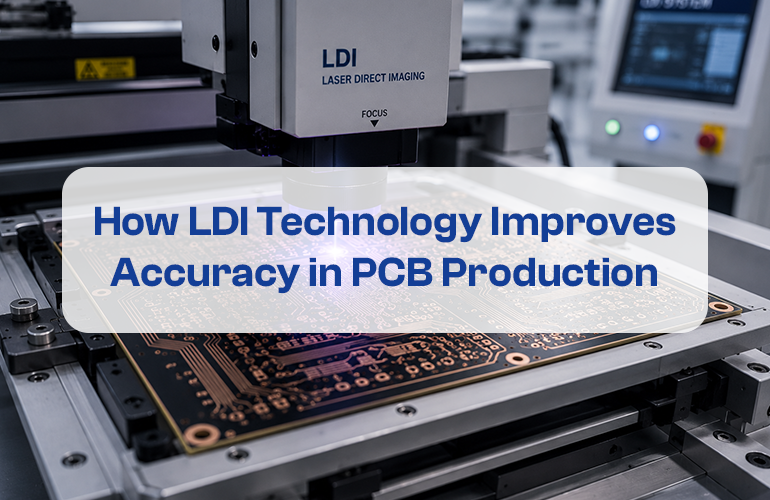
LDI (Laser Direct Imaging) technology has transformed PCB manufacturing by enhancing design accuracy and reducing errors. Traditional PCB production relies on physical masks to transfer designs onto copper sModern PCB manufacturing requires exceptional precision and consistency. Therefore, manufacturers increasingly rely on Laser Direct Imaging (LDI) technology to produce high-quality circuit boards. Unlike traditional imaging methods, LDI uses lasers to transfer PCB designs directly onto copper-clad substrates. As a result, manufacturers achieve greater accuracy, faster production, and improved reliability.
What is LDI Technology?
LDI uses high-powered lasers to project circuit patterns directly onto a PCB surface. Unlike conventional photolithography, LDI does not rely on physical masks. Instead, it creates circuit images digitally with exceptional precision.
Consequently, manufacturers can achieve highly accurate alignment for traces, pads, and vias. Furthermore, this technology supports modern high-density PCB designs that require extremely fine features.
Increased Precision in PCB Production
Precision plays a critical role in PCB manufacturing. LDI places traces and component pads exactly where designers intend them to be. In contrast, traditional mask-based methods may introduce alignment variations during exposure.
As a result, LDI minimizes trace width inconsistencies and reduces the likelihood of electrical faults. Therefore, manufacturers can produce high-performance PCBs with greater confidence.
Higher Quality and Consistency
Computer-controlled laser systems deliver repeatable and accurate imaging. Moreover, they eliminate many of the manual errors associated with older manufacturing techniques.
Consequently, every production batch maintains a high level of consistency. This reliability makes LDI particularly valuable for telecommunications, aerospace, and medical electronics applications.
Faster Turnaround Times
Manufacturers do not need physical masks when using LDI technology. Therefore, they can begin production much faster.
Additionally, engineering teams can implement design modifications quickly without waiting for new masks. As a result, companies can accelerate product development and reduce time-to-market.
Enhanced Design Flexibility
Modern electronic devices demand compact and sophisticated PCB layouts. Fortunately, LDI supports intricate circuit designs, fine-pitch layouts, and HDI boards with exceptional accuracy.
Furthermore, manufacturers can create miniature circuit features without sacrificing quality. Consequently, LDI helps support the growing demand for advanced electronic products.
Cost-Effective for Low-Volume Production
Prototype development often involves multiple design revisions. Because LDI eliminates mask creation costs, manufacturers can produce small batches more economically.
In addition, startups and R&D teams can validate designs faster and more efficiently. Therefore, they can optimize both development costs and project timelines.
Reduced Risk of Defects
Accurate imaging directly improves product quality. LDI reduces issues such as misaligned traces, incorrect pad dimensions, and imaging defects.
As a result, manufacturers achieve higher production yields and better PCB reliability. Moreover, fewer defects reduce rework costs and improve overall manufacturing efficiency.
How TruePCB Uses LDI Technology
At TruePCB, LDI technology plays a key role in the PCB manufacturing process.
High-Precision Imaging
LDI ensures accurate alignment of traces, pads, and vias across both prototype and production boards. Consequently, customers receive highly reliable circuit boards.
Rapid Prototyping
TruePCB enables startups and engineers to manufacture prototype batches quickly. Furthermore, the company eliminates delays associated with mask production.
High-Density PCB Manufacturing
TruePCB uses LDI to manufacture multilayer and high-density PCBs with fine-line circuitry. As a result, customers can develop advanced electronic products with confidence.
Integrated Quality Verification
TruePCB combines LDI with AOI (Automated Optical Inspection) systems. Therefore, the company verifies every circuit pattern before production advances to the next stage.
Improved Production Efficiency
TruePCB eliminates mask setup requirements and streamlines the imaging process. Consequently, the company delivers faster turnaround times for prototype and low-volume production runs.
By leveraging advanced LDI technology, TruePCB ensures that every PCB meets strict quality, accuracy, and performance standards.
Conclusion
LDI technology has transformed modern PCB manufacturing. It improves accuracy, enhances consistency, reduces defects, and accelerates production processes.
Furthermore, it supports high-density designs, rapid prototyping, and cost-effective low-volume manufacturing. As a result, manufacturers can deliver reliable, high-performance PCBs for demanding applications.
Whether developing a prototype or scaling production, companies can rely on LDI technology to achieve superior manufacturing quality and performance.