
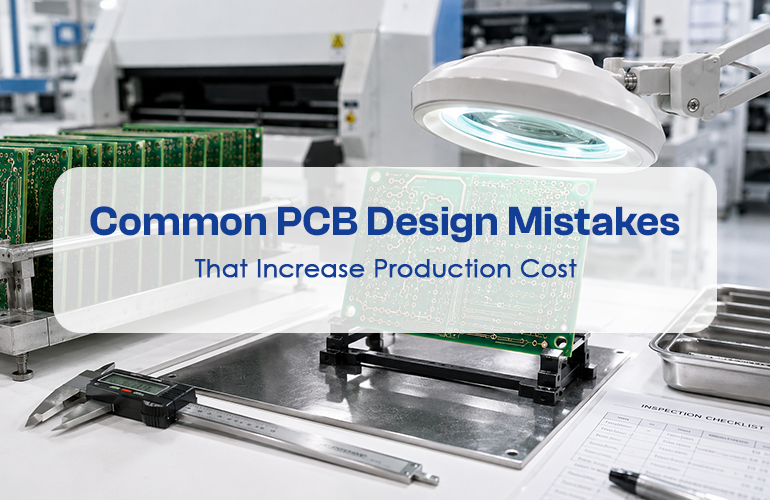
In the electronics manufacturing process, PCB design plays a critical role in determining both performance and production cost. Even small design errors can lead to significant cost increases during manufacturing. Therefore, understanding common PCB design mistakes that increase production cost is considered essential for improving efficiency and avoiding unnecessary expenses.
By identifying these mistakes early, better design decisions can be made, and overall project costs can be controlled effectively.
Incorrect Component Placement
One of the most frequent issues in PCB design is improper component placement. When components are not positioned logically, routing becomes more complex, and additional layers may be required.
As a result, manufacturing costs are increased, and production time may also be extended. Proper placement strategies should be followed to avoid such common PCB design mistakes that increase production cost.
Overly Complex Routing
Routing complexity is often increased when design planning is not done efficiently. Unnecessary trace lengths, sharp angles, and overlapping paths can make the PCB difficult to manufacture.
When such issues are present, additional processing steps may be required, which directly impacts cost. Therefore, simplified and optimized routing should be maintained to reduce common PCB design mistakes that increase production cost.
Ignoring Design for Manufacturability (DFM)
Design for Manufacturability (DFM) guidelines are often overlooked during the design phase. When DFM principles are not followed, the design may not be suitable for efficient production.
This can result in higher rejection rates, rework, and delays. By following DFM practices, many common PCB design mistakes that increase production cost can be avoided, and smoother production can be ensured.
Improper Layer Selection
Choosing the wrong number of layers can also impact production costs. In some cases, more layers than necessary are used, which increases manufacturing complexity and expense.
On the other hand, using fewer layers than required can lead to routing issues and design limitations. Therefore, correct layer selection must be done carefully to prevent common PCB design mistakes that increase production cost.
Inadequate Testing Considerations
Testing requirements are sometimes not considered during the design stage. When proper test points are not included, additional effort is required during inspection and validation.
This can increase both time and cost in later stages. By planning testing requirements in advance, such common PCB design mistakes that increase production cost can be minimized.
Lack of Standardization
Non-standard design practices can also lead to higher production costs. When custom or uncommon specifications are used, manufacturing becomes more complicated and expensive.
Standard design rules and widely accepted specifications should be followed to ensure cost efficiency and reduce common PCB design mistakes that increase production cost.
Conclusion
PCB design errors can have a direct impact on production cost, efficiency, and overall product quality. By understanding common PCB design mistakes that increase production cost, better decisions can be made during the design phase.
When proper planning, standardization, and manufacturability guidelines are followed, costs can be controlled, and production can be optimized. Therefore, avoiding these mistakes is essential for achieving efficient and cost-effective PCB manufacturing.