
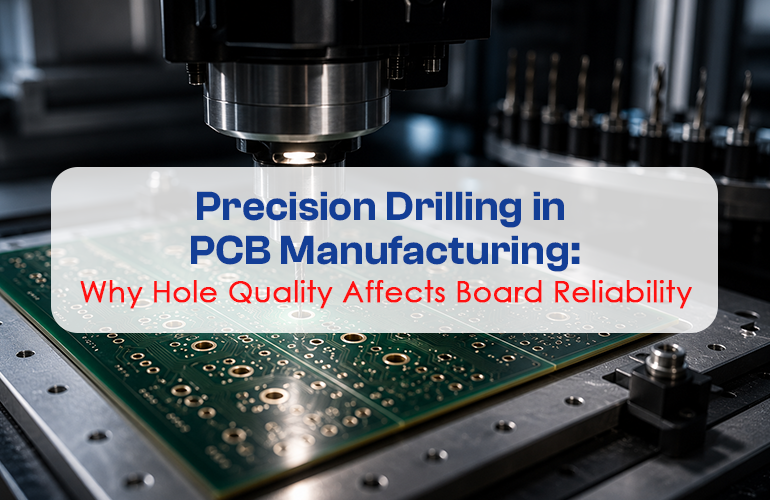
Precision drilling in PCB manufacturing is important because holes are essential to the structure and function of a printed circuit board. Holes are used for component mounting, vias, plated through holes, slots, and mechanical support.
If hole quality is poor, the PCB may face electrical connection issues, component fitment problems, or long-term reliability failures. Therefore, precision drilling plays a major role in PCB performance.
What Is Precision Drilling?
Precision drilling means creating PCB holes with accurate size, location, and quality. These holes must match the design files and support proper plating or assembly.
In simple boards, drilling accuracy is important. In multilayer PCBs and compact designs, it becomes even more critical.
Role of Vias
Vias connect different layers of a PCB. In multilayer boards, vias help signals and current move between layers.
If a via is drilled incorrectly, it may not connect properly. This can cause open circuits or unreliable performance.
Plated Through-Hole Reliability
Plated through holes are drilled holes coated with copper. They create electrical connections from one side of the board to another or between multiple layers.
Hole wall quality, plating consistency, and alignment are important for reliable plated through-hole performance.
Component Fitment
Many components need drilled holes for mounting. If the holes are too large, too small, or misplaced, assembly becomes difficult.
This can lead to soldering problems, weak mechanical support, and production delays.
Impact on Multilayer PCBs
Multilayer PCBs require accurate drilling because each hole may pass through several internal layers. A drilling error can affect multiple connections at once.
Precision drilling helps maintain layer alignment, via reliability, and board consistency.
Inspection After Drilling
Drilling should be supported by inspection and testing. Visual checks, cross-section analysis, and electrical testing help verify hole quality and plating performance.
This helps reduce the risk of failure during assembly or use.
How True PCB Supports Precision Drilling
True PCB supports precision drilling as part of its advanced PCB fabrication capabilities. Its custom PCB fabrication services include precision drilling, multilayer PCB fabrication, fine track designs, controlled impedance boards, and surface finish options.
True PCB’s PCB manufacturing process also highlights drilling as an important stage for creating reliable electrical connections between PCB layers. It mentions the use of CNC drilling for accurate hole placement on simple and multilayer PCBs.
Conclusion
Precision drilling in PCB manufacturing affects hole quality, via reliability, component fitment, and long-term PCB performance. Poor drilling can create electrical and mechanical problems.
By choosing a PCB manufacturer with precision drilling capability and inspection support, engineers can improve board reliability from the production stage itself.