
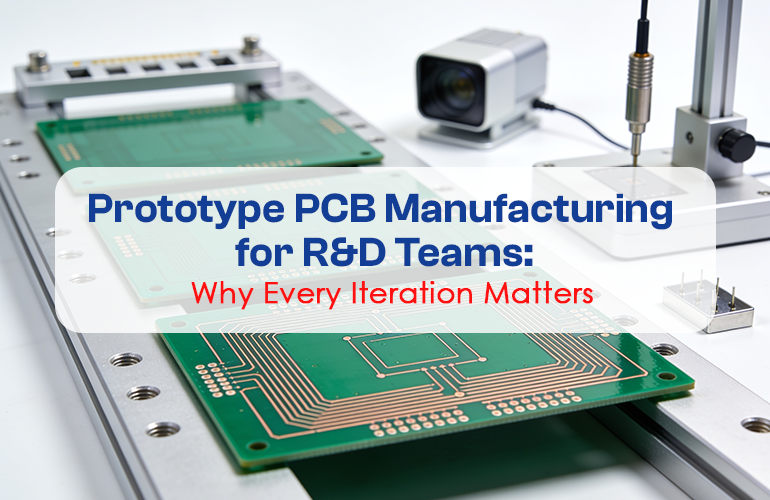
Prototype PCB manufacturing is an important part of the R&D process. Research and development teams use prototypes to test ideas, validate designs, and improve product performance before moving toward production.
Every PCB iteration gives engineers new information. It helps them understand whether the design works as planned, where improvements are needed, and how the board performs in real conditions.
Why R&D Teams Need PCB Prototypes
R&D teams often work on new products, updated designs, or application-specific electronic solutions. These projects require testing before final approval.
A PCB prototype gives the team a physical board to test. This makes it easier to identify design flaws, confirm functionality, and make better development decisions.
Every Iteration Improves the Design
The first version of a PCB may not be perfect. Testing may reveal issues related to layout, component placement, heating, signal flow, mechanical fitment, or assembly.
Each new prototype version helps correct these issues. This iterative process brings the design closer to production readiness.
Reduces Development Risk
Without prototype testing, problems may appear during assembly or field use. These late-stage problems can be expensive and time-consuming to solve.
Prototype PCB manufacturing helps reduce risk by finding issues early. This allows R&D teams to make improvements before larger production begins.
Supports Faster Decision-Making
R&D projects often work under strict timelines. Faster prototype availability helps teams test faster, review results faster, and decide the next step faster.
This is especially important for companies working on competitive product development or urgent engineering improvements.
Helps Validate Real-World Performance
A PCB design may look correct in software, but actual performance depends on real conditions. Prototypes help test electrical behavior, thermal response, fitment, and reliability.
This gives R&D teams practical insights that cannot always be gained from design files alone.
Connects Prototype to Small Batch Production
Once the prototype is approved, the next step is often small batch PCB manufacturing. This helps validate the design in limited quantities before scaling further.
A manufacturer that supports both prototype and small batch requirements can make this transition smoother.
How True PCB Supports R&D PCB Prototyping
True PCB supports R&D teams with prototype PCB manufacturing, small batch production, multilayer PCB capability, material options, surface finishes, and testing support. This helps engineers move through design iterations with better speed and confidence.
For R&D projects, True PCB’s manufacturing approach focuses on precision, quality checks, and application readiness. Whether the requirement is a basic prototype, a complex multilayer board, or a performance-sensitive PCB, True PCB helps teams validate ideas before production decisions are made.
Conclusion
Prototype PCB manufacturing for R&D teams helps turn ideas into tested, improved, and production-ready designs. Every iteration matters because it reveals useful information and reduces development risk.
With the right prototype PCB manufacturer, R&D teams can move faster, make better decisions, and develop more reliable electronic products.