
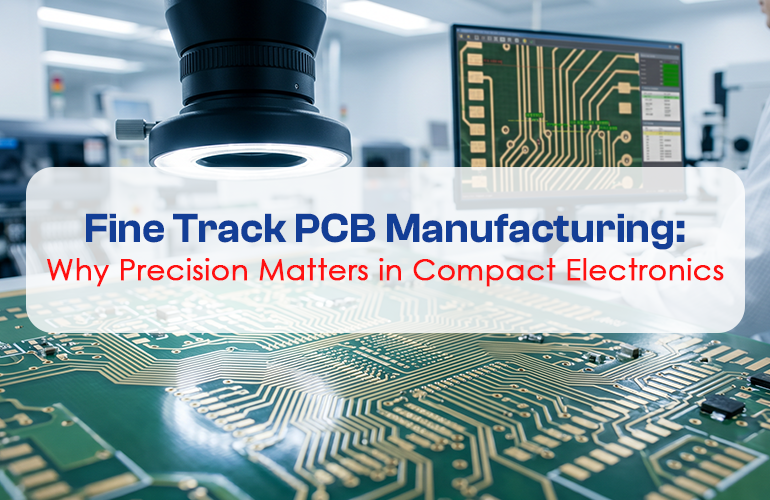
Fine track PCB manufacturing is critical for compact and advanced electronic devices. As products become smaller and more powerful, PCB designs must fit more routing into limited space. This requires narrow tracks, controlled spacing, and accurate circuit patterns.
Fine track PCBs allow engineers to design compact boards without compromising performance. However, precise manufacturing is essential because even small errors can affect connectivity, signal flow, and overall reliability.
What Are Fine Tracks in PCB Manufacturing?
Fine tracks are narrow copper pathways that connect components on a PCB. They carry signals or current between parts of a circuit.
In compact PCB designs, fine tracks help engineers fit more connections into a smaller area. This is common in modern electronics, IoT devices, communication systems, control modules, medical equipment, and advanced industrial products.
Why Fine Track Accuracy Matters
Accuracy is vital because the distance between tracks is often very small. If track width is incorrect, it can lead to:
- Open circuits
- Short circuits
- Performance issues
Producing fine tracks consistently requires precise imaging, etching, plating, and inspection. Controlled processes and advanced equipment are therefore essential.
Supports Compact PCB Design
Fine track PCB manufacturing enables efficient space usage. Engineers can reduce board size without sacrificing routing complexity.
This is especially important for space-sensitive products like handheld devices, sensors, IoT modules, and automation controllers.
Improves Routing Flexibility
Fine tracks give designers more layout options, allowing more connections without increasing board dimensions. This is particularly helpful in multilayer PCBs, where multiple signal paths must be carefully managed.
Helps Advanced Electronic Applications
Fine track PCBs are widely used in high-density, performance-sensitive applications. Accurate tracks ensure reliable boards and simplify testing and validation.
Precision in track geometry directly affects the performance of high-speed circuits, complex communication modules, and advanced industrial electronics.
Manufacturing Challenges
Producing fine track PCBs requires close control over:
- Track width and spacing
- Copper thickness
- Solder mask clearance
- Inspection processes
Any variation in these parameters can compromise performance. Engineers should confirm that the manufacturer has the capability to meet these precise requirements before finalizing the design.
How TruePCB Supports Fine Track PCB Manufacturing
True PCB specializes in fine track PCB manufacturing for compact and high-density designs. They provide:
- Advanced imaging, drilling, and plating processes
- Precise inspection and testing
- Support for multilayer PCBs
- Controlled spacing and tolerance management
TruePCB helps engineers, startups, and R&D teams manufacture boards where precision is crucial, ensuring high performance in compact layouts and technically demanding designs.
Conclusion
Fine track PCB manufacturing is essential for compact and advanced electronics. It enables dense routing, reduces board size, and supports complex circuits.
Precision is the key factor: with the right manufacturing process, fine track PCBs deliver reliable performance in high-density and space-sensitive applications. Partnering with a capable manufacturer like TruePCB ensures boards are accurate, reliable, and ready for advanced electronics.