
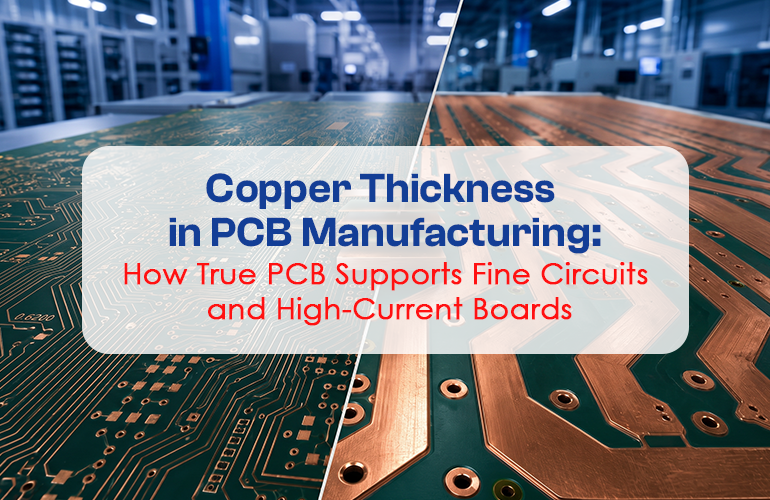
Copper thickness in PCB manufacturing plays an important role in how a printed circuit board performs. Copper is responsible for carrying electrical signals and current across the board. Therefore, the thickness of copper directly affects current capacity, heat management, durability, and circuit reliability.
Different electronic applications need different copper thickness levels. Fine circuit designs may need thinner copper for precise tracks and compact layouts, while high-current boards may need thicker copper to support heavier electrical loads. Understanding copper thickness helps engineers choose the right PCB manufacturing approach.
What Is Copper Thickness in PCB?
Copper thickness refers to the amount of copper used on the conductive layers of a PCB. It is usually measured in microns or ounces. The selected copper thickness depends on the current requirement, trace width, heat generation, and application type.
A standard electronic board may not need very thick copper. However, power electronics, industrial equipment, automotive electronics, and high-load circuits often require higher copper thickness for better performance.
Why Copper Thickness Matters
Copper thickness affects how much current a PCB track can carry. If the copper is too thin for the required current, the track may heat up or fail over time.
It also affects voltage drop, thermal behavior, and long-term reliability. This is why engineers should not treat copper thickness as a basic specification. It should be planned based on actual circuit performance needs.
Copper for Fine Circuit Designs
Fine circuit designs need precision. These boards often have narrow tracks, compact spacing, and dense routing. In such cases, copper thickness must be suitable for achieving clean and accurate circuit patterns.
If copper is too thick for a fine circuit layout, it may become difficult to maintain very small track width and spacing. Therefore, the right balance between copper thickness and circuit design is important.
Copper for High-Current Boards
High-current PCBs require stronger copper support. These boards are commonly used in power electronics, motor control systems, battery systems, industrial machines, and automotive applications.
Thicker copper helps carry higher current and manage heat more effectively. It also improves the board’s ability to handle demanding electrical loads.
Manufacturing Considerations
Copper thickness affects etching, plating, drilling, solder mask application, and final inspection. A board with higher copper thickness may need more controlled processing.
Before production begins, engineers should clearly share current requirements, copper weight, layer details, and performance expectations with the PCB manufacturer.
How True PCB Supports Copper Thickness Requirements
True PCB supports different copper thickness requirements for both fine circuit layouts and high-current PCB applications. This helps customers manufacture boards based on the actual needs of their design.
For fine circuits, True PCB’s manufacturing process supports controlled track width and spacing. For high-load designs, the company supports high copper build PCB manufacturing to improve current handling and thermal reliability. This makes True PCB suitable for customers working on compact electronics, power electronics, industrial systems, and performance-sensitive boards.
Conclusion
Copper thickness in PCB manufacturing directly affects board performance, current capacity, heat control, and reliability. Fine circuit boards need precision, while high-current boards need stronger copper support.
By selecting the right copper thickness and working with an experienced PCB manufacturer, engineers can improve both product performance and manufacturing quality.