
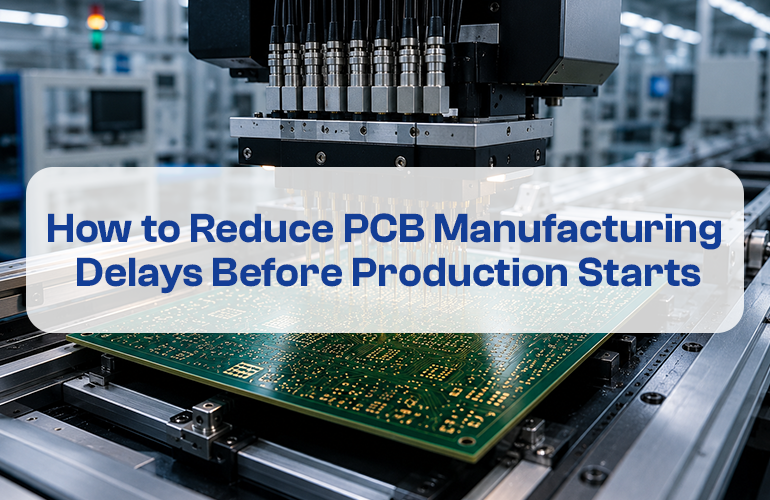
PCB manufacturing delays often happen before production even begins. Incomplete files, unclear specifications, missing details, wrong material selection, and late approvals can slow down the process.
For companies working on prototypes, R&D projects, small batch production, or urgent PCB requirements, delays can affect development timelines and product launches. The good news is that many delays can be reduced with better preparation.
Send Complete Gerber Files
Gerber files are the main production files for PCB manufacturing. They should include all required copper layers, solder mask layers, silkscreen layers, paste layers, and board outline.
If any layer is missing or unclear, the manufacturer may need clarification before production can begin.
Include Accurate Drill Files
Drill files are required for vias, plated through holes, mounting holes, and slots. Missing or incorrect drill files can create major production issues.
Engineers should check drill size, hole count, plated and non-plated hole details, and slot information before submission.
Confirm Material Requirements
PCB material affects performance and availability. Standard materials may be easier to process quickly, while special materials may need more planning.
If the material requirement is not confirmed early, production may be delayed.
Share Copper Thickness Details
Copper thickness affects current carrying capacity, heat behavior, and manufacturability. Engineers should mention copper thickness clearly, especially for high-current boards and fine circuit designs.
Unclear copper requirements can delay quotation, review, and production.
Mention Surface Finish
Surface finish should be selected before production. Options such as HASL, lead-free HASL, immersion gold, immersion tin, and OSP may be selected based on application and assembly needs.
Clear surface finish selection helps avoid last-minute confusion.
Provide Stack-Up Details for Multilayer PCBs
For multilayer boards, stack-up details are important. Layer order, dielectric thickness, copper weight, and controlled impedance requirements should be shared clearly.
Without these details, production review may take longer.
Approve Technical Queries Quickly
Sometimes the manufacturer may raise questions before production. Quick responses help avoid unnecessary waiting time.
Clear communication between the customer and manufacturer is one of the best ways to reduce PCB manufacturing delays.
How True PCB Helps Reduce PCB Manufacturing Delays
True PCB supports design-to-production requirements with responsive service and accurate execution. Its custom PCB fabrication support includes prototype PCB builds, small batch orders, industrial PCB projects, custom dimensions, special material requirements, and fast development runs.
True PCB also serves clients across India with responsive communication, efficient logistics, and dependable production systems, which helps customers manage development-stage and production-stage PCB requirements more smoothly.
Conclusion
PCB manufacturing delays can often be reduced before production starts. Complete files, clear material details, copper thickness, surface finish selection, stack-up information, and fast communication all help improve timelines.
Better preparation helps the manufacturer start production faster and helps customers receive more reliable PCBs within practical timelines.