
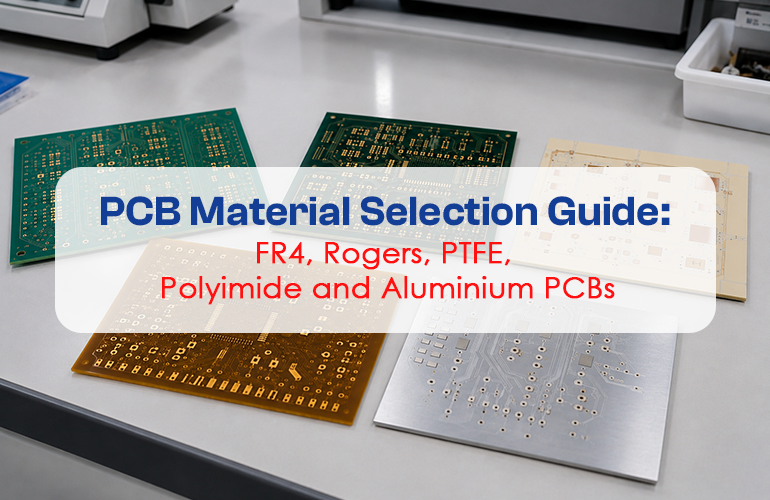
PCB material selection is an important part of PCB manufacturing. The material used in a printed circuit board affects its strength, heat resistance, signal performance, flexibility, and long-term reliability.
Every electronic product has different requirements. Some boards need basic performance, while others need high-frequency stability, heat dissipation, or flexible design. Therefore, understanding PCB materials helps engineers make better design and manufacturing decisions.
Why PCB Material Selection Matters
The PCB material forms the base of the board. It supports copper tracks, components, insulation, and electrical performance. If the wrong material is selected, the board may face heating issues, signal loss, mechanical failure, or performance instability.
Material selection becomes even more important in applications like RF electronics, power electronics, LED systems, industrial equipment, medical devices, and automotive electronics.
FR4 PCB Material
FR4 is one of the most commonly used PCB materials. It is suitable for general electronic applications because it offers good mechanical strength and electrical insulation.
FR4 PCBs are widely used in consumer electronics, control boards, industrial products, and standard electronic devices. For many prototype PCB manufacturing projects, FR4 is the first choice because it is practical and cost-effective.
Rogers PCB Material
Rogers material is commonly used for high-frequency and RF PCB applications. It provides better signal stability compared to standard materials in frequency-sensitive designs.
Rogers PCBs are useful in telecom, RF control boards, communication systems, and high-speed electronic circuits. When signal integrity is important, Rogers material can help improve performance.
PTFE PCB Material
PTFE is another material used in high-frequency PCB applications. It offers strong electrical performance and is suitable for designs that require stable signal transmission.
PTFE PCBs are often used in RF, microwave, antenna, and communication-related applications. These boards require careful manufacturing control because material handling and processing are more specialized.
Polyimide PCB Material
Polyimide is known for flexibility and heat resistance. It is often used in flexible PCBs and applications where the board may need to bend or handle higher temperatures.
This material is useful in compact devices, wearable electronics, aerospace electronics, and other designs where space and movement matter.
Aluminium PCB Material
Aluminium PCBs are used where heat dissipation is important. They are commonly found in LED lighting, power electronics, and heat-sensitive applications.
The metal base helps transfer heat away from the components, improving performance and product life.
How True PCB Supports PCB Material Selection
True PCB works with multiple PCB material options such as FR4, Rogers, PTFE, Polyimide, Aluminium, and other special-purpose materials. This helps engineers select the right base material depending on the application, whether the board needs standard performance, high-frequency stability, flexibility, or better heat dissipation.
By offering material flexibility along with prototype and small batch PCB manufacturing, True PCB helps customers build boards that are better suited to real performance requirements.
Conclusion
PCB material selection directly affects board performance and reliability. FR4, Rogers, PTFE, Polyimide, and Aluminium each serve different requirements.
Before starting PCB manufacturing, engineers should discuss material needs with their manufacturer. The right material helps create a PCB that performs better, lasts longer, and supports the exact needs of the application.