
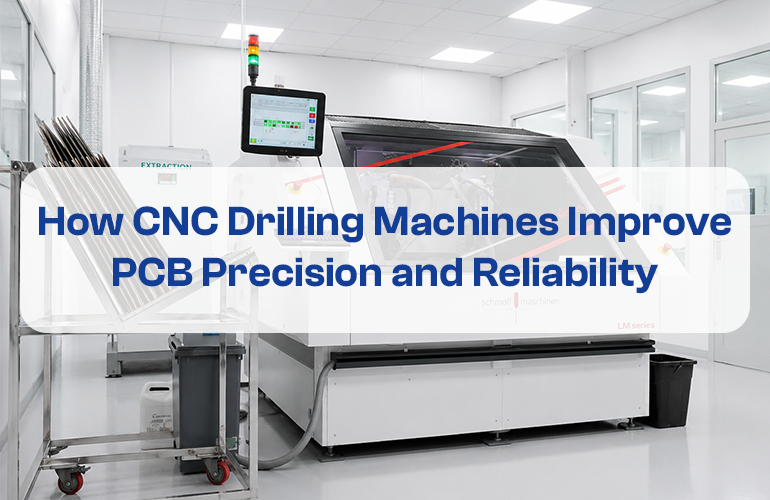
Precision is one of the most critical factors in PCB manufacturing, especially when it comes to drilling. CNC drilling machines are essential tools in the PCB production process, improving the accuracy and reliability of the boards. These machines drill holes with exceptional precision, ensuring that components are placed correctly and that electrical pathways are uninterrupted. In this blog, we explore how CNC drilling machines enhance PCB precision and reliability, leading to better performance in electronic devices.
What is CNC Drilling?
CNC (Computer Numerical Control) drilling is an automated process used to create precise holes for component leads, vias, and other electrical connections. CNC machines follow a computer program to guide the drill bit to the exact location and depth on the PCB. This ensures every hole is drilled at the correct position with minimal variation, which is critical for the board’s functionality.
Improved Precision in Hole Placement
CNC drilling machines place holes with extreme accuracy. Even minor misalignments can cause component misfit, poor electrical connections, or total system failure. Computer-controlled CNC machines ensure every hole is drilled exactly as specified, improving PCB quality and overall reliability.
High-Speed and Consistent Production
CNC drilling machines work continuously at high speeds without sacrificing precision. Every board is drilled identically, providing consistent results. This speed and consistency are crucial for industries like telecommunications, aerospace, and medical devices.
Enhanced Reliability in High-Density Designs
For high-density interconnect (HDI) PCBs, CNC drilling enables the production of small, closely spaced holes that traditional methods cannot achieve. This ensures modern electronic devices maintain high performance and reliability even in complex designs.
Reduced Risk of Defects
Manual drilling can introduce errors such as inconsistent hole depth or misalignment. CNC machines eliminate human error, ensuring every PCB is drilled to strict standards. This reduces defective boards, improves yield, and enhances product reliability.
Cost Efficiency and Reduced Waste
Although CNC machines have higher upfront costs, their precision reduces rework and scrap. Faster production times and optimized raw material usage lower overall costs, making CNC drilling highly cost-efficient.
Role in Quality Control
CNC drilling machines are integral to PCB quality control. Automated checks verify hole dimensions and placement, ensuring each board meets design specifications. This contributes to mechanical strength, electrical performance, and overall reliability.
How TruePCB Uses CNC Drilling Machines
At TruePCB, CNC drilling machines are a core part of the manufacturing process. They use advanced CNC systems to:
- Drill multi-layer PCBs with extreme precision, supporting HDI designs and small-pitch components.
- Ensure consistent hole size and placement across all prototypes and production boards, reducing errors.
- Integrate with automated inspection systems, including AOI and XRF testing, for full quality verification.
- Support rapid prototyping, allowing startups and engineers to quickly iterate on designs without delays.
- Optimize production efficiency, reducing material waste and lowering per-unit costs.
By combining CNC drilling with other advanced manufacturing technologies, TruePCB ensures that every PCB they produce meets stringent quality standards, is highly reliable, and ready for high-performance applications .
Conclusion
CNC drilling machines have transformed PCB manufacturing by significantly improving precision, reliability, and production efficiency. TruePCB leverages these machines to produce high-quality boards that support complex, high-density designs with accuracy and consistency. Using CNC technology not only reduces defects and rework but also accelerates prototyping and full-scale production, ensuring that startups and manufacturers can deliver reliable electronics products to the market.