
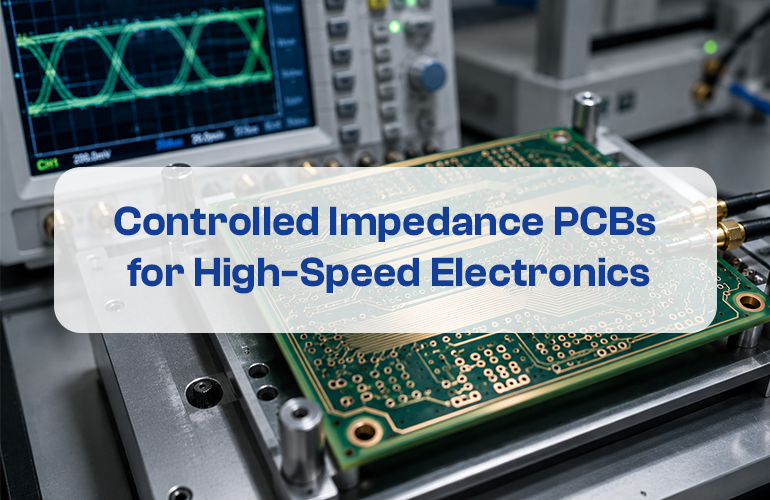
Modern electronics rely on high-speed signals in communication systems, computing devices, and industrial equipment. As signal speed increases, maintaining stability becomes more difficult. Therefore, understanding the role of controlled impedance PCB design is essential for reliable performance.
Controlled Impedance PCB Design Basics
Controlled impedance refers to maintaining consistent electrical resistance along PCB traces. Designers achieve this by controlling trace width, spacing, and material properties.
When impedance remains stable, signals travel smoothly without distortion. As a result, this design approach improves signal accuracy.
Signal Integrity in High-Speed Circuits
High-speed circuits operate at very high frequencies. If impedance is not controlled, signal reflections and degradation can occur.
Therefore, maintaining signal integrity becomes critical. Proper impedance control ensures stable signal flow and better system performance.
Noise Reduction and Stable Signal Flow
Signal loss and electromagnetic interference are common challenges in advanced electronics. Poor impedance control can introduce noise and reduce performance.
By optimizing signal paths, this method reduces interference and improves signal quality. As a result, devices operate more efficiently.
High-Speed Applications and Performance Needs
Applications such as telecommunications, data centers, and computing systems require accurate signal transmission. Even small inconsistencies can affect performance.
In these environments, controlled impedance design ensures signals remain stable and consistent.
Design Considerations for Controlled Impedance
Achieving controlled impedance requires proper design planning. Engineers must consider trace geometry, material selection, and layer stack-up.
If these factors are not optimized, variations can occur. Therefore, careful design ensures consistent electrical performance.
Reliability and Long-Term Performance
Reliable performance is critical in high-speed devices. Signal instability can lead to system failures.
With proper design techniques, this approach improves durability and ensures long-term performance.
Conclusion
Controlled impedance plays an important role in PCB design for high-speed electronics. It supports signal integrity, reduces noise, and improves system performance.
By focusing on proper design methods, manufacturers can build reliable and efficient electronic systems.